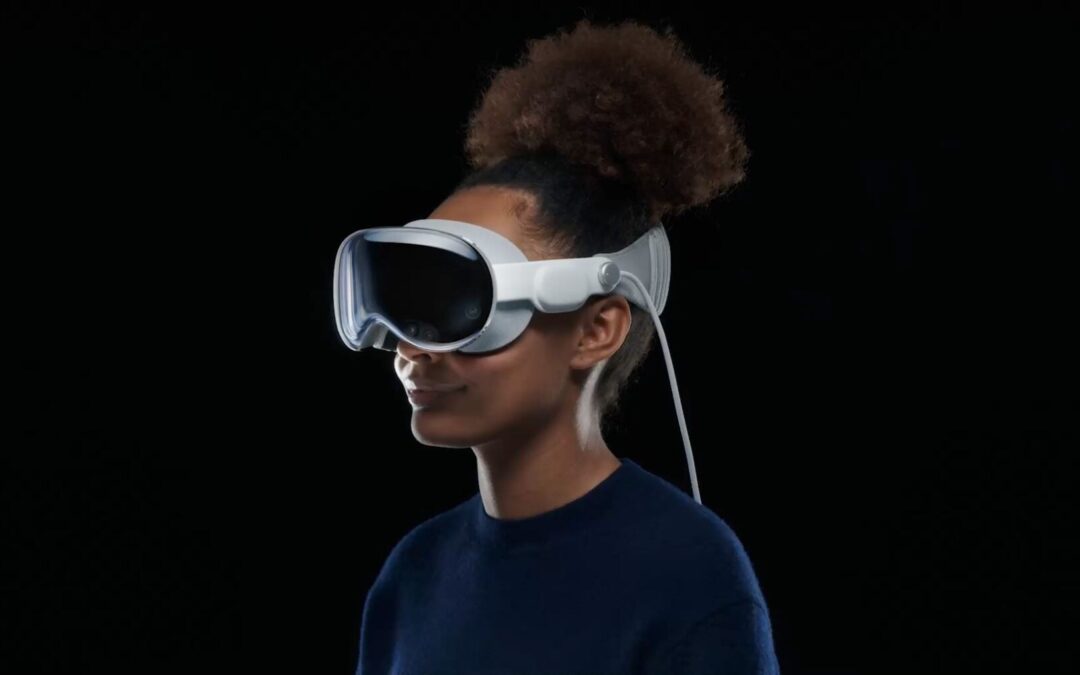

Poor gross sales have reportedly pressured Apple to chop manufacturing of the Imaginative and prescient Professional headset that it had hoped would herald a brand new period in “spatial computing”.
The tech firm additionally lowered advertising for Imaginative and prescient Professional by greater than 95 % final 12 months, based on the market intelligence group Sensor Tower in figures first reported by the Monetary Occasions.
Apple continues to promote iPhones, iPads and laptops within the thousands and thousands every quarter, however analysts say gross sales of Imaginative and prescient Professional headsets, which value a minimum of £3,199 ($3,499) every, have been sluggish.
Apple has not launched gross sales figures for the system, however the market analysis group Worldwide Information Company (IDC) estimates it would have bought solely 45,000 within the final quarter of final 12 months.
IDC stated Apple’s Chinese language producer, Luxshare, had stopped manufacturing of the headset at first of 2025, and Apple has not expanded direct gross sales past a choose 13 nations.
Counterpoint Analysis has predicted a 14 % discount in annual gross sales of digital actuality headsets.
The obvious failure of Imaginative and prescient Professional has echoes of the ill-fated Google Glass in 2013. Customers have been shunned as social pariahs or “glassholes”.
Regardless of these setbacks tech companies are persisting with good glasses. Apple is predicted to launch a less expensive model of Imaginative and prescient Professional later this 12 months, however the emphasis now’s on AI-enabled units.
Stories within the tech press stated Apple had paused its deliberate subsequent iteration of digital actuality in favour of wearable AI units. Mark Zuckerberg’s Meta can also be anticipated to chop again on its plans for a “metaverse”, which incorporates its digital actuality Quest headsets. These are much less superior than Apple’s product however at £419 every are significantly cheaper and have cornered 80 % of the market.
Meta confirmed final month that it was “shifting a few of our investments from metaverse in direction of AI glasses and different wearables”.
Apple has refused to touch upon the experiences that it’s scaling again digital actuality headsets.
If confirmed, the cuts to Imaginative and prescient Professional would characterize a uncommon industrial flop for an Apple product.
When it launched Imaginative and prescient Professional in 2023, Apple hoped the units, which permit customers to work together with apps utilizing eye actions, would have the identical success as Macs and iPhones. On the product launch Tim Cook dinner, Apple’s chief government, stated: “Your environment turn out to be an infinite canvas … Imaginative and prescient Professional blends digital content material into the area round us. It’s going to introduce us to spatial computing.”
However shoppers balked on the price ticket and reviewers complained that the units have been heavy, uncomfortable and little greater than a gimmick. There was additionally alarm when customers have been filmed carrying the headsets whereas driving.
Even fans admit the headsets solely have area of interest attraction and that the expertise of carrying them could be isolating from different folks.
The restricted variety of apps out there in contrast with telephones and tablets can also be thought to have restricted curiosity in Imaginative and prescient Professional.
Morgan Stanley’s tech analyst Erik Woodring summed up its issues. “We are able to say the associated fee, kind issue and the shortage of VisionOS native apps are the the explanation why the Imaginative and prescient Professional by no means bought broadly,” he instructed the FT.
Apple says there are 3,000 apps out there for Imaginative and prescient Professional headsets. That could be a comparatively small quantity in contrast with the proliferation after the launch of the iPhone in 2007.
Study extra:
Style Is Already Attempting to Money In on Apple’s Imaginative and prescient Professional
Mytheresa, J.Crew and E.l.f. Cosmetics are among the many retailers to have developed apps for the newly launched ‘spatial computing’ headset as they attempt to leverage its capabilities for extra immersive, emotional purchasing experiences.